
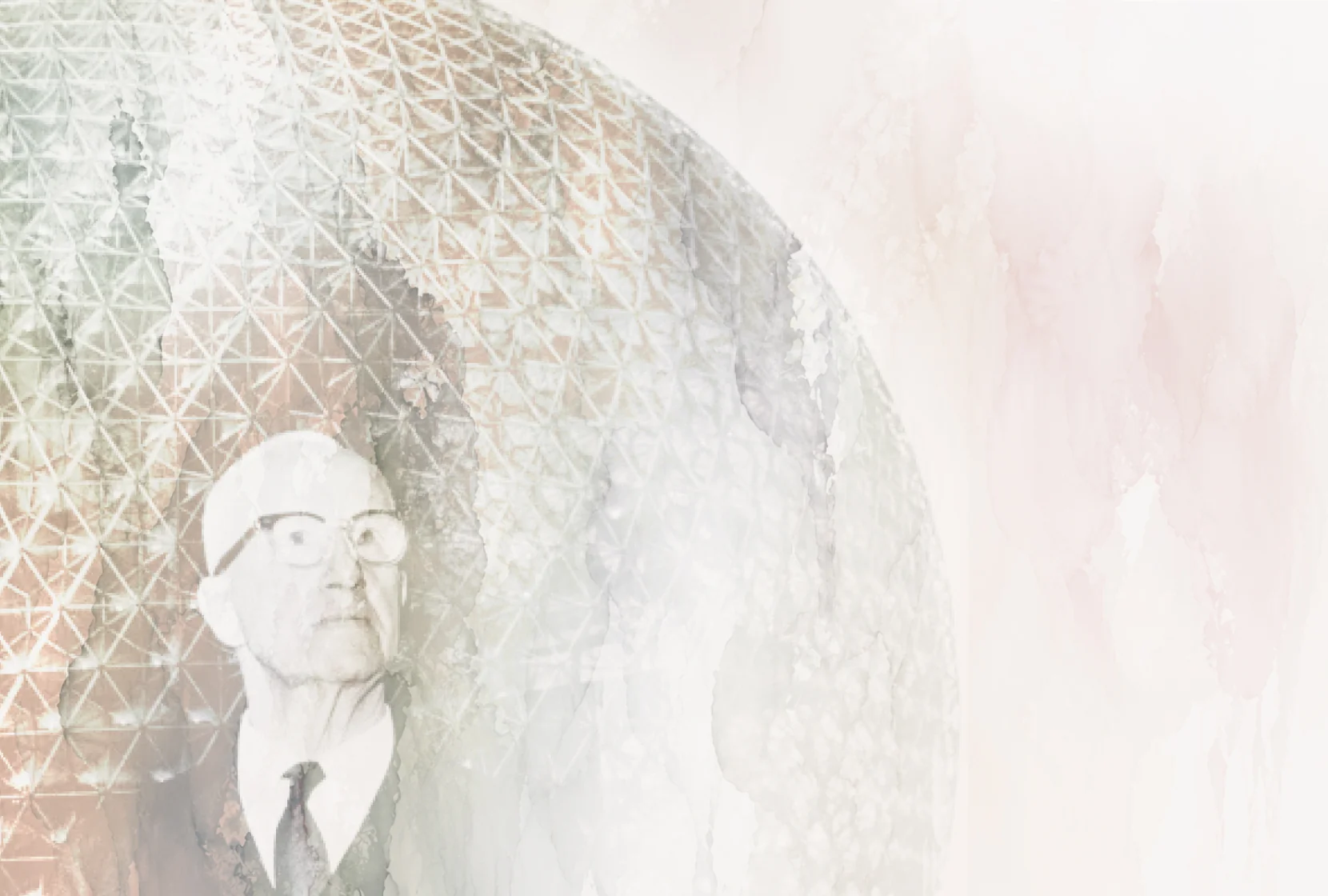
Fuller’s Chronofile was not a tidy journal or a productivity stunt. It was a lifelong attempt to place one person’s experience beside a century of technological change.
A life treated as a case history
In a 1967 essay titled Man With a Chronofile, R. Buckminster Fuller wrote that he began collecting documents of his own development as a child. In 1917, while serving in the United States Navy, he decided to use that material more systematically: his life would become a case history correlated with changes in technology and the wider world. He named the documentation the Chronofile.
The ambition was larger than memory. Fuller was born in 1895 and believed his generation was living through a change in human environment unlike the shifts experienced by several generations before him. The archive let him place letters, events, travel, inventions, and public trends on a shared timeline.
The record was meant to reveal patterns
Fuller’s essay does not present the Chronofile as a scrapbook of highlights. He describes reading the record for long movements: new relationships between distance and time, accelerating technological change, and what he called doing more with less. By 1927, he said, patterns visible in the Chronofile had helped him formulate the large design questions that would guide his work.
This is the interesting shift. A record that begins as evidence of what happened becomes an instrument for asking what is changing. The value is not perfect recollection. It is the ability to set moments beside one another and notice a direction that was difficult to see from inside any single day.
Separate the archive from the legend
Stories about Fuller’s logging often become more precise as they travel. Popular summaries describe exhaustive intervals and total documentation. The primary 1967 account reviewed for this article supports the early collecting, the systematic turn in 1917, the name Chronofile, and its use as a personal-technological case history. It does not instruct readers to write an entry every fifteen minutes.
The surviving institutional record is undeniably extensive. Southern Illinois University’s archive notes that the primary collection of Fuller’s papers is held by Stanford University Libraries. But the scale of an archive is not evidence that every popular detail about its method is accurate. Where frequency is undocumented, it should stay undocumented.
Total capture has a cost
Fuller had an unusual project and built an unusual archive around it. Most people do not need to preserve the receipts of an entire life. Exhaustive logging can crowd out the experience it is meant to illuminate, create pressure to record ordinary moments, and generate an archive too large to revisit.
A smaller system can borrow the principle without borrowing the scale. Keep traces that change your interpretation: a decision, a surprise, a contradiction, a beginning, or an ending. The archive becomes useful when it is selective enough to read and specific enough to challenge memory.
Three receipts from today
Leave three timestamped notes before the day ends. In the first, record what changed. In the second, record what surprised you. In the third, record what you decided. Do not turn the exercise into continuous surveillance. Three points are enough to create a small distance between the person living the day and the person reviewing it.
Return a week later and ask what those notes make visible. Perhaps decisions repeatedly occur under pressure. Perhaps surprises cluster around the same person or place. Perhaps change was happening where you felt stuck. Fuller’s radical archive invites a modest experiment: give tomorrow’s self enough evidence to see today from the outside.